Living up here in Detroit, I have had a chance this season to see quite an enjoyable, albeit frustrating at times, Tigers team. They did win the AL Central and got to the World Series, which is awesome, but like most all teams, they have you scratching your head during the season. Part of what makes being a fan so much fun, I guess.
As most folks know, Prince Fielder was added to the team this season w/ a huge long term contract, bringing over his wonderful power to go with his good eye and nice hitting ability (we won't talk about running or fielding here, ok? :) ).
Stories have already been written about how the combination of Fielder and Miguel Cabrera was going to and did form a formidable duo in the middle of the lineup. This duo did produce as Cabrera batting 3rd, produced a Triple Crown season - .330, 44 HR, 139 RBI, while Prince Fielder, batting 4th, produced a .313, 30, 108 line.
What has not been talked about too much is the Intentional Walks that they were issued - Fielder, 18 and Cabrera, 17. This gave them the #1 & #2 positions in the AL.
This got me thinking as to how often this has occurred in MLB history. Well, first of all, IBB's have only been "officially" recorded since 1955 (based on what I see in B-R), so I had to limit myself to 1955 to date - no checking on Crawford/Cobb; Ruth/Gehrig, though these and other combos may well have been 1-2 in their leagues.
After going through all of the leader boards from 1955 to present, I found 4 other seasons in which the top 2 players in IBB's were from the same team:
Note - I have not researched the pitching hand of the pitcher/batter in this research,which can be a significant factors for a manager in deciding to issue an IBB.
1. 1964 - NY Yankees: Mickey Mantle (18), Elston Howard (14)
Team finish: 1st in AL
Primary Batting Positions:
Mantle - 4th (109 of 132 starts)
Howard - 7th (56), 5th (40), 6th (32) of 141 starts
Times batting back to back - 54 times
Men on Base:
Mantle: -2-, 9; -23, 5 (-2- means runner on 2nd only, -23, means runners on 2nd & 3rd only)
Howard: -2-, 8 -23, 5
Batting Position and hitter after on IBB:
Mantle (18) (.303, 177 OPS+)
4th, Tom Tresh (.246, 105 OPS+, SwHit) - 8 times
4th, Howard - 8
Howard (14) (.313, 127 OPS+)
7th, Clete Boyer (.218, 58 OPS+) - 5
5th, Joe Pepitone (.251, 90 OPS+, bats L) - 4 (1 other time w/ EH batting 5th)
Side note - B-R total shows 12 IBB for Howard, but game logs add it up to 14 - error request has been sent to B-R
About half of Mantle's IBB were followed by a much more inferior hitter in Tresh, while Howard was the next hitter in the same number - some of these may have been matchup walks, but I think that it had mostly to do w/ an open base and a 177 OPS+ staring at the opposing pitcher.
As for Howard, who moved around the lineup a bit, both Boyer and Pepitone definitely represented much lesser threats. The 54 times that Mantle & Howard hit back-to-back was 2nd in this "survey" to the Cabrera/Fielder combination.
2. 1973 - SF Giants: Willie McCovey (25), Dave Rader (23)
Team finish: 3rd in NL West
Primary Batting Positions:
McCovey - 4th, 116 of 116 starts (130 total games)
Rader- 8th all 135 starts
Times batting back to back - 0
Men on Base:
McCovey: -2-, 10; -23, 9
Rader: -23, 9; -2-, 8; --3, 6
Batting Position and hitter after on IBB:
McCovey (25) (.266, 162 OPS+)
4th, Ed Goodson (.302, 112 OPS+, LH) - 15 times
Rader (23 (.229, 84 OPS+)
8th, Pitcher
The first of 2 1-2 IBB leaders in which one of the 2 hitters was the 8th place hitter. Willie McCovey was IBB'ed a lot in his career, in fact he held the season total record (since 1955) of 45 in 1970 until Barry Bonds came along. Ed Goodson hit behind him and actually was hitting pretty good for the 1st part of the season. A young 3b by the name of Dave Kingman also hit behind McCovey on a few occasions and in fact had 5 rbi's on a 3 run homer and 2 run single after 2 IBB's in a May 6th game.
As for Rader, your typical NL #8 hitter - good field, no hit, catcher or ss.
3. 1980 - Montreal Expos: Warren Cromartie (24), Chris Speier (18)
Team finish: 2nd in NL East
Primary Batting Positions:
Cromartie - 5th, 80; 6th, 45; 7th, 34 of 160 starts
Speier - 8th, 115 of 122 starts
Times batting back to back - 18 times
Men on Base:
Cromartie: -2-, 16; -23, 5; --3, 4
Speier: -2-, 9; -23, 7
Batting Position and hitter after on IBB:
Cromartie (24) (.288, 116 OPS+)
6th/5th - Larry Parrish (.254, 104 OPS+) - 11
5th/6th - Gary Carter (.264, 126 OPS+) - 7
Speier (18) (.265, 92 OPS+)
8th, Pitcher
I was very surprised to see Cromartie as the leader in IBB's. I do remember the name and that was about it (they were all up North in that ugly place called Olympic Stadium). He had a decent year, but nothing that would shout out IBB! And look at the hitters behind him, both names that you have heard of. Granted Parrish's numbers are nothing special, but still. I did a little more digging on Cromartie and saw that he hit .353 in June and .321 in July, surrounded by mostly sub .270 numbers. What happened in June & July for Cromartie, I am not sure, but he received half of his 24 IBB's in those 2 months, He received 9 more in Sept/Oct when he had an OPS of .713.
As for Speier, see Dave Rader above. Ironically, Speier was on the '73 team w/ McCovey and Rader. He was IBB'ed 4 times that season.
4. 1988 - Boston Red Sox: Wade Boggs (18), Mike Greenwell (18)
Team finish: 1st in AL East
Primary Batting Positions:
Boggs - 1st, 91; 3rd, 63
Greenwell - 4th, 99; 5th, 55 of 158 starts
Times batting back to back - 18 times
Men on Base:
Boggs: -23, 9; -2-, 5; --3, 4
Greenwell: -2-, 11; -23, 4
Batting Position and hitter after on IBB:
Boggs (18) (.366, 168 OPS+)
1st - Marty Barrett (.283, 85 OPS+) - 10
3rd - Jim Rice (.264, 102 OPS+) - 4
Greenwell (18) (.325, 160 OPS+) (BL)
4th, Ellis Burks (.294, 132 OPS+) - 12
The Boggs/Greenwell combination represents the best duo OPS+ of the 5 teammates with Boggs at 168 and Greenwell at 160 (2nd and 4th). Both Boggs and Greenwell sat in 2 different lineup positions during the season. pretty much revolving around Ellis Burks. Boggs batted 3rd in the lineup for a good deal of the 1st 2 months while Burks was batting 1st. When Burks switched out of the top spot, Boggs became the primary leadoff hitter, Burks moved down to 5th and shifted Greenwell from 5th to 4th. Boggs led the AL in IBB's 6 straight seasons from 1987-1992, something that I guess I didn't expect since he is not a "slugger", but when you think about it, Boggs was as dangerous as any slugger if a runner was in scoring position in this time period. And needless to say, Marty Barrett represented a much smaller threat to the pitcher. Interestingly a veteran Jim Rice, in his penultimate season was up next after Boggs' IBBs 4 times. Greenwell raised another type of situation. He was in his peak season, although he had some other nice seasons and 1 year younger and sophomore player in Burks batted after him. For those that are familiar with the 1988 Red Sox, they were a solid team all the way through and lead the league in BA, OBA, SLG, OPS+. In addtion to Boggs and Greenwell, Dwight Evans (136) and Burks (132) had OPS+'s over 130. Unfortunately, they ran into a superhot A's team and were swept 4 straight in the ALCS.
5. 2012 - Detroit Tigers: Prince Fielder (18), Miguel Cabrera (17)
Team finish: 1st in AL Central
Primary Batting Positions:
Cabrera - 3rd, 161
Fielder - 4th, 162
Times batting back to back - 161 times
Men on Base:
Cabrera: -2-, 9; --3, 5
Fielder: -2-, 10; -23, 5
Batting Position and hitter after on IBB:
Fielder (18) (.313, 152 OPS+) (BL)
4th - Delmon Young (.267, 89 OPS+) - 10
4th - Brennan Boesch (.240, 77 OPS+) - 5
Cabrera (17) (.330, 165 OPS+)
3rd, Fielder - 17
To me, what makes the Cabrera/Fielder feat unique this year is that they batted back-to-back ALL season. Without looking up the actual numbers, I know that the main reason (if not for all of the occurrences) that Cabrera was IBB'ed, was to set up a lefty-lefty matchup. Fielder's Lefty-Righty splits seem to bear out the relative wisdom as his slash lines were:
vs. RHP: .328//439/.579 - 1.017
vs. LHP: .289/.363/.445 - .808
Still not bad, but definitely worth the risk to Int walk Cabrera.
BTW, Fielder has been the IBB leader now in both leagues, having led the NL in 2011 w/ 32 IBB's
Cabrera led the AL in IBB's in 2010 w/ also 32.
Not sure, but this may be the only time that 2 teammates have both had 30 IBB seasons on the same team (different seasons of course). I haven't checked, so if anyone else knows if there are others, please let me know.
-----------------------------------------------------------------------------
One project I would love to explore in the future (unless someone else has already) is the result after the IBB is issued. Who were the best and worst hitters in that spot; which managers had the best/worst "luck" w/ issuing an IBB.
Wednesday, October 31, 2012

Thursday, August 16, 2012
Random 1890 AA thoughts
Well, I haven't made the time to post in a little while - summer does that, I suppose.
Anyway, I am slowly plugging my way through the 1890 AA - doing my same thing, entering lineups, retro stuff, and batter k's into my access database.
So far, I have entered the home games for the following teams - Rochester, Philadelphia, Brooklyn, Louisville, & am into July with Syracuse.
For those familiar with base ball in 1890, this was one of those years with 3 "major" leagues, the other being 1884. As a result, you tend to see a few things that you wouldn't normally.
First, coming from my research in 1887-8, where the cities were ones that I had considered major cities, I lept into the 1890 AA, which played ball in Toledo, Columbus, Syracuse, & Rochester, cities that I don't normally think of as "major league". In 1889, in fact, Toledo had a good deal of its team on its International League entry, the "Black Pirates"; Syracuse & Rochester were the same. Brooklyn started the 1890 season with its only AA entry, which was "abandoned" in late August, only to be replaced by Baltimore, which had operated in the Atlantic League. I am thinking Baltimore may be the last "team" to operate as a minor and major league team in the same season. Granted, the 1890 Orioles did pick up a number of players from other AA teams, but it was still Billy Barnie's Atl League team (as well as his 1889 AA team).
Why for all of the jumble and use of "minor league" teams - that is pretty apparent - the Players League was added to the mix, which resulted in NL/AA players jumping to the PL and the AA scrambling to have a team. David Nemec's "Beer and Whisky League" book does a much better job of explaining this all, I am finding it fascinating dealing with players that I had never heard of. I would be curious to know what percentage of players in the 1890 AA only played that 1 season (NL & PL as well). With the minor league fill-ins, it seems like a lot. I imagine someone could argue if the 1890 AA was really of "Major League" quality or if it really was a mostly a minor league in Major League clothing.
One thing that I discovered when going through the Louisville games was a wholy different "walk-off" rule than I had ever heard of.
I first ran across this when doing the Louisville home games.
On April 19, 1890, Louisville scored 2 in the bottom of the 10th to
beat St. Louis 5-3. Louisville did bat last in this
game. According to the Philadelphia Inquirer, Shinnick singled home
2 runners in the bottom of the 10th with 1 out to win it for the Colonels.
I had never heard of 2 runs in a "sudden death" situation w/ a
non-homer in any era (let alone in this era).
I posted this to the 19th century Yahoo group and Cliff Blau graciously responded with the following:
The rule at the time was that on a game-winning play such as this,
the game continued until the play was over. I came across one
instance where the defensive team didn't bother to field the ball and
the batter circled the bases for a homer.
The 1889 rules state:
"If the side last at bat in the ninth inning scores the winning run
before the third man is out, the game shall terminate, upon the
return of the ball to the pitcher."
Cliff later noted that the rule must have been changed soon after, because by 1894 it said that the game ended with the "winning run". I have run across a couple of other occurrences of this, both at Louisville, on April 29 and June 11. Interesting coincidence that these all occurred in Louisville? Not sure.
That is all for today. Hope I can be more diligent on blog entries as I have a ton of stuff to post, but less intiative and skill. Hope whoever is reading these posts are enjoying them.
Cheers,
Jonathan
Anyway, I am slowly plugging my way through the 1890 AA - doing my same thing, entering lineups, retro stuff, and batter k's into my access database.
So far, I have entered the home games for the following teams - Rochester, Philadelphia, Brooklyn, Louisville, & am into July with Syracuse.
For those familiar with base ball in 1890, this was one of those years with 3 "major" leagues, the other being 1884. As a result, you tend to see a few things that you wouldn't normally.
First, coming from my research in 1887-8, where the cities were ones that I had considered major cities, I lept into the 1890 AA, which played ball in Toledo, Columbus, Syracuse, & Rochester, cities that I don't normally think of as "major league". In 1889, in fact, Toledo had a good deal of its team on its International League entry, the "Black Pirates"; Syracuse & Rochester were the same. Brooklyn started the 1890 season with its only AA entry, which was "abandoned" in late August, only to be replaced by Baltimore, which had operated in the Atlantic League. I am thinking Baltimore may be the last "team" to operate as a minor and major league team in the same season. Granted, the 1890 Orioles did pick up a number of players from other AA teams, but it was still Billy Barnie's Atl League team (as well as his 1889 AA team).
Why for all of the jumble and use of "minor league" teams - that is pretty apparent - the Players League was added to the mix, which resulted in NL/AA players jumping to the PL and the AA scrambling to have a team. David Nemec's "Beer and Whisky League" book does a much better job of explaining this all, I am finding it fascinating dealing with players that I had never heard of. I would be curious to know what percentage of players in the 1890 AA only played that 1 season (NL & PL as well). With the minor league fill-ins, it seems like a lot. I imagine someone could argue if the 1890 AA was really of "Major League" quality or if it really was a mostly a minor league in Major League clothing.
One thing that I discovered when going through the Louisville games was a wholy different "walk-off" rule than I had ever heard of.
I first ran across this when doing the Louisville home games.
On April 19, 1890, Louisville scored 2 in the bottom of the 10th to
beat St. Louis 5-3. Louisville did bat last in this
game. According to the Philadelphia Inquirer, Shinnick singled home
2 runners in the bottom of the 10th with 1 out to win it for the Colonels.
I had never heard of 2 runs in a "sudden death" situation w/ a
non-homer in any era (let alone in this era).
I posted this to the 19th century Yahoo group and Cliff Blau graciously responded with the following:
The rule at the time was that on a game-winning play such as this,
the game continued until the play was over. I came across one
instance where the defensive team didn't bother to field the ball and
the batter circled the bases for a homer.
The 1889 rules state:
"If the side last at bat in the ninth inning scores the winning run
before the third man is out, the game shall terminate, upon the
return of the ball to the pitcher."
Cliff later noted that the rule must have been changed soon after, because by 1894 it said that the game ended with the "winning run". I have run across a couple of other occurrences of this, both at Louisville, on April 29 and June 11. Interesting coincidence that these all occurred in Louisville? Not sure.
That is all for today. Hope I can be more diligent on blog entries as I have a ton of stuff to post, but less intiative and skill. Hope whoever is reading these posts are enjoying them.
Cheers,
Jonathan
Wednesday, July 18, 2012
2 or more consecutive team starts - 1887-88 AA
I have been working on batter strikeouts and lineups for the 19th century American Association as a number of previous blog posts have noted. I have finally got through entering all of my lineups into my Access databases for the 1887 & 1888 seasons.
I still am waiting scans of good deal of home 1887 Louisville games from 3 or 4 Louisville papers from my UK source (who has a full time job too, so I am very patient). Right now my batter k documented pct for the whole 1887 season is at 79.4% - this is driven primarily by the lack of decent game writeups from the Louisville papers. I have been having scans made of the Courier-Journal, Times, & Post. So far, I have scans through the end of May. Yesterday, I discovered a 4th possible paper, the Commercial. I am hoping that either the Commercial's coverage is better or that any of the papers coverage picks up in June. :)
While I am waiting on this, as follow-up to my previous post of 2 or more consecutive team starts in the 1897-1912 era, I am posting here similar information on my 2 completed AA seasons.
It serves as an interesting contrast, but also illustrates that even by 1887, the concept of the "iron man" who would pitch multiple consecutive team games was already slowly becoming a myth. Indeed there are a couple of pitchers who still fit the mold, but overall there was alot less than I anticipated. Not exactly 4 or 5 man rotations, but more 2-3 man rotations.
As you see below there were 12 occurrences of 3 or more consecutive starts, 2 of those, which I will highlight below, extended to 4 straight start occurrences.
I will present spreadsheets similar to what I did in the previous blog post:
First, I want to present the overall numbers of consecutive team starts by year:
Quite a difference from the highest total of the latter era, where the greatest total was 34 and that was in the 12 team 1899 NL - a less than 3 average consecutive start occurrences per team.
By contrast, in the 8 team AA, the average is 7-8 per team (the "3" and "4" in the above table are included in the lesser #'s respectively. As noted, this is to be expected, based on "how the game was played" and managed - smaller rosters, shorter distances, etc. Interestingly, teams averaged over 6.5 runs per game in 1887, with St. Louis having an amazing 8.2 runs per game. Cleveland & New York allowed an average of nearly and over 8 runs a game.
If we look at which pitchers contributed to these numbers, we see the following:
The overall leader for the 2 seasons is Toad Ramsey. What I discovered in my research is 2 main things about Toad Ramsey -
1. He liked to drink (Pete Browning, no doubt, was a frequent drinking buddy) which resulted in various fines/suspensions/gone missings.
2. He struck out a bunch of batters. In fact, in 1887 he had 7 games where he struck out 10 or more. 3 pitchers were in a distant 2nd (Mike Morrison, Elmer Smith, & Matt Kilroy) with only 2 each.
What struck me more than learning a bunch more about Ramsey was how, the 2 top pitchers, Ramsey & Kilroy, with the most basically dropped off the face of the earth in 1888. Pitching 500-600 innings has a tendency to hurt the arm and this tends to show that.
Granted this is a very limited study, only 2 years, but anyone who would like to add thoughts on this, I would love to hear from you.
The 2 occurrences with 4 consecutive team starts were the following:
Toad Ramsey, Louisville, 1887 - June 23, 24, 26, & 27:
6/23: at Cin - Lost 3-1. Ramsey allowed 6 hits and 3 "phantom hits" (walks). He also struck out 6.
6/24: at Cin -Won 10-9, barely surviving as he gave up 3 runs in the top of the 9th. He allowed 13 hits and a walk.
6/26: at Cin -Won 7-3. Game was tied at 2-2 thru 6, the Colonels score 4 in the 7th & 1 in th 8th. Ramsey allows 7 hits & 2 walks while striking out 9.
6/27: at Cin -Won 12-11. Louisville was up 8-6 going after 7. Cincinnati scored 2 in the 8th & 3 in the 9th to take a 11-8 lead going to the bottom of the 9th. Browning, Chicken Wolf, and Reddy Mack singled producing the 1st 2 runs. White single moved Mack to 3rd, where he scored momentarily when Cincy's catcher muffed a 4th strike, batter Werrick being thrown out at 1st as Mack raced home with the 3rd run and White to 3rd. Ramsey then hit a grounder to Bid McPhee who threw home to try to catch White. The throw was low and Keenan could not handle it as White scored the winning run. Ramsey gave up 18 hits and 5 walks while
Silver King, St. Louis, 1888 - July 23, 25, 26, & 27:
7/23: at Louisville - Lost 10-4. King allowed 6 in the 8th to make a 4-4 tie into a Colonel blowout. King allowed 14 hits and 3 walks. He struck out 2.
7/25: at Baltimore - Won 5-2. King allowed 5 hits and 2 walks while striking out 5.
7/26: at Baltimore - Won 7-1. King allowed 6 hits and 2 walks while striking out 3.
7/27: at Baltimore - Won 9-5. King allowed 8 hits. He had no walks or strikeouts.
King actually pitched in the next game, 7/28. He started in rightfield, swapping positions with Tommy McCarthy in the 2nd inning for Tommy McCarthy. King switched back to rightfield in the 8th.
King then started on the 29th, before Nat Hudson started and completed the game on the 30th.
Apparently, part of the reason for King's consecutive start string was due to "sickness of Hudson and Devlin".
So King pitched in 6 straight games, starting 5 of them and pitching in all but about 6 innings of that stretch.
In respect to pitching both ends of a doubleheader, there were not too many, part of this probably due to lower number of doubleheaders.
I still am waiting scans of good deal of home 1887 Louisville games from 3 or 4 Louisville papers from my UK source (who has a full time job too, so I am very patient). Right now my batter k documented pct for the whole 1887 season is at 79.4% - this is driven primarily by the lack of decent game writeups from the Louisville papers. I have been having scans made of the Courier-Journal, Times, & Post. So far, I have scans through the end of May. Yesterday, I discovered a 4th possible paper, the Commercial. I am hoping that either the Commercial's coverage is better or that any of the papers coverage picks up in June. :)
While I am waiting on this, as follow-up to my previous post of 2 or more consecutive team starts in the 1897-1912 era, I am posting here similar information on my 2 completed AA seasons.
It serves as an interesting contrast, but also illustrates that even by 1887, the concept of the "iron man" who would pitch multiple consecutive team games was already slowly becoming a myth. Indeed there are a couple of pitchers who still fit the mold, but overall there was alot less than I anticipated. Not exactly 4 or 5 man rotations, but more 2-3 man rotations.
As you see below there were 12 occurrences of 3 or more consecutive starts, 2 of those, which I will highlight below, extended to 4 straight start occurrences.
I will present spreadsheets similar to what I did in the previous blog post:
First, I want to present the overall numbers of consecutive team starts by year:
| Year | 2 | 3 | 4 | Grand Total |
| 1887 | 60 | 6 | 1 | 67 |
| 1888 | 54 | 6 | 1 | 61 |
| Grand Total | 114 | 12 | 2 | 128 |
Quite a difference from the highest total of the latter era, where the greatest total was 34 and that was in the 12 team 1899 NL - a less than 3 average consecutive start occurrences per team.
By contrast, in the 8 team AA, the average is 7-8 per team (the "3" and "4" in the above table are included in the lesser #'s respectively. As noted, this is to be expected, based on "how the game was played" and managed - smaller rosters, shorter distances, etc. Interestingly, teams averaged over 6.5 runs per game in 1887, with St. Louis having an amazing 8.2 runs per game. Cleveland & New York allowed an average of nearly and over 8 runs a game.
If we look at which pitchers contributed to these numbers, we see the following:
| 2 or more Consecutive Starts | |||
| Year | |||
| player | 1887 | 1888 | Grand Total |
| Ramsey | 15 | 3 | 18 |
| Ma Kilroy | 10 | 1 | 11 |
| Seward | 4 | 6 | 10 |
| King | 1 | 8 | 9 |
| Mullane | 4 | 5 | 9 |
| Bakley | 8 | 8 | |
| Porter | 3 | 4 | 7 |
| E Smith | 5 | 1 | 6 |
| Caruthers | 2 | 4 | 6 |
| G Weyhing | 4 | 1 | 5 |
| Mays | 5 | 5 | |
| P Smith | 2 | 2 | 4 |
| Hughes | 3 | 3 | |
| Hudson | 3 | 3 | |
| Crowell | 2 | 2 | |
| Cunningham | 2 | 2 | |
| Kirby | 1 | 1 | |
| Shaw | 1 | 1 | |
| M Morrison | 1 | 1 | |
| Chamberlain | 1 | 1 | |
| Weidman | 1 | 1 | |
| Foutz | 1 | 1 | |
| Grand Total | 60 | 54 | 114 |
The overall leader for the 2 seasons is Toad Ramsey. What I discovered in my research is 2 main things about Toad Ramsey -
1. He liked to drink (Pete Browning, no doubt, was a frequent drinking buddy) which resulted in various fines/suspensions/gone missings.
2. He struck out a bunch of batters. In fact, in 1887 he had 7 games where he struck out 10 or more. 3 pitchers were in a distant 2nd (Mike Morrison, Elmer Smith, & Matt Kilroy) with only 2 each.
What struck me more than learning a bunch more about Ramsey was how, the 2 top pitchers, Ramsey & Kilroy, with the most basically dropped off the face of the earth in 1888. Pitching 500-600 innings has a tendency to hurt the arm and this tends to show that.
Granted this is a very limited study, only 2 years, but anyone who would like to add thoughts on this, I would love to hear from you.
The 2 occurrences with 4 consecutive team starts were the following:
Toad Ramsey, Louisville, 1887 - June 23, 24, 26, & 27:
6/23: at Cin - Lost 3-1. Ramsey allowed 6 hits and 3 "phantom hits" (walks). He also struck out 6.
6/24: at Cin -Won 10-9, barely surviving as he gave up 3 runs in the top of the 9th. He allowed 13 hits and a walk.
6/26: at Cin -Won 7-3. Game was tied at 2-2 thru 6, the Colonels score 4 in the 7th & 1 in th 8th. Ramsey allows 7 hits & 2 walks while striking out 9.
6/27: at Cin -Won 12-11. Louisville was up 8-6 going after 7. Cincinnati scored 2 in the 8th & 3 in the 9th to take a 11-8 lead going to the bottom of the 9th. Browning, Chicken Wolf, and Reddy Mack singled producing the 1st 2 runs. White single moved Mack to 3rd, where he scored momentarily when Cincy's catcher muffed a 4th strike, batter Werrick being thrown out at 1st as Mack raced home with the 3rd run and White to 3rd. Ramsey then hit a grounder to Bid McPhee who threw home to try to catch White. The throw was low and Keenan could not handle it as White scored the winning run. Ramsey gave up 18 hits and 5 walks while
Silver King, St. Louis, 1888 - July 23, 25, 26, & 27:
7/23: at Louisville - Lost 10-4. King allowed 6 in the 8th to make a 4-4 tie into a Colonel blowout. King allowed 14 hits and 3 walks. He struck out 2.
7/25: at Baltimore - Won 5-2. King allowed 5 hits and 2 walks while striking out 5.
7/26: at Baltimore - Won 7-1. King allowed 6 hits and 2 walks while striking out 3.
7/27: at Baltimore - Won 9-5. King allowed 8 hits. He had no walks or strikeouts.
King actually pitched in the next game, 7/28. He started in rightfield, swapping positions with Tommy McCarthy in the 2nd inning for Tommy McCarthy. King switched back to rightfield in the 8th.
King then started on the 29th, before Nat Hudson started and completed the game on the 30th.
Apparently, part of the reason for King's consecutive start string was due to "sickness of Hudson and Devlin".
So King pitched in 6 straight games, starting 5 of them and pitching in all but about 6 innings of that stretch.
In respect to pitching both ends of a doubleheader, there were not too many, part of this probably due to lower number of doubleheaders.
| Started both ends of DH | |||
| Year | |||
| player | 1887 | 1888 | Grand Total |
| Ma Kilroy | 2 | 2 | |
| P Smith | 1 | 1 | |
| Seward | 1 | 1 | |
| Mullane | 1 | 1 | |
| Grand Total | 3 | 2 | 5 |
Tuesday, July 10, 2012
2 or more consecutive starts 1897-1912
I recently read of Zack Greinke having 3 consecutive starts for his team. They were not complete games, but I thought I would check my lineup databases from my research to see how often that occurred in the years of my research. Other research indicated that Greinke's feat was the first time since 1917 & Red Faber that it occurred. Stories of Joe McGinninty and much earlier eras of consecutive starts made me want to check.
Below is my summary of players with 3 consecutive starts in my research years (1897-1909 NL & 1901-1912 AL):
Win Mercer, Wash (NL), 1897 - 9/13 (ejected in 3rd), 9/14 (CG), 9/15 (CG)
9/13 - Mercer was thrown out of the game versus Cincinnati in the 3rd by Carpenter for "criticising the umpire's ruling on a ball". Mercer "resorted to a pantomimical play by prospecting his pocket and pulling out a pair of smoked spectacles and handing them to Carpenter." He left the game with the score 0-0. Washington ended up losing an 8 inning darkness shortened 2-1 decision.
9/14 - Won a 10-9 6 inning darkness shortened decision. Washington scored 1 in the 5th & 4 in the 6th to overcome a 9-5 defecit to the Cincinnatis. Mercer allowed 7 hits (4 doubles), 4 walks, & 1 hbp. He struck out 3 batters.
9/15 - Lost a 5-4 decision to Brooklyn. Allowed the winning run with 2 outs in the bottom of the 9th. Mercer allowed 8 hits & 3 walks. He struck out 5.
Mercer's inclusion with the rest of the names on this list stands out. A talented all around player who hit and played in the field as well - he would later be known for committing suicide
Joe McGinnity, Balt (AL), 1901 - 9/9 (CG), 9/12, G1 (CG), 9/12, G2 (CG) - ALL Complete Games!
9/9: McGinnity lost a darkness shortened 8-4 decision at Detroit. He allowed 14 hits and walked 2. He struck out 2.
9/12, Game 1: "Iron Man" as we was already being referred to as, won game 1 4-3 versus Philadelphia when the Orioles scored 2 in the bottom of the 9th. McGinnity allowed 7 hits and walked 3. He struck out 2. The Orioles scored their 2 winning runs on a Jimmy Williams triple, and singles by Bill Keister, Steve Brodie, and Wilbert Robinson.
9/12, Game 2: McGinnity lost 5-4 in game 2 on a Philadelphia run in the 9th. McGinnity allowed 10 hits, a walk, and an hbp. He struck out none.
3 consecutive team complete games, albeit one was shortened by darkness. 1-2 record.
Rube Waddell, Phil (AL), 1904 - 6/5 (pulled after 3), 6/6 (CG), 6/7 (CG)
6/5: Waddell was batted out of the box in the 3rd inning in Chicago in a 14-2 loss. According to the Philadelphia Record, he "asked permission of Manager Mack to pitch the entire 4 game series, thereby establishing for himself a record that would stand for a long time unequaled". Waddell gave up 7 hits and 3 runs in his outing. Chief Bender reilieved him after 3 and he gave up 3 runs as well. Barthold came in in the 6th and finished out the game. Waddell did walk 1 and strike out 3 in his brief outing.
6/6: Rube was back out there for game 2 of the Chicago series. This time he was a bit more successful, winning 6-3. He allowed 8 hits and 2 walks. He struck out 5.
6/7: In game 3 of the series, Waddell lost 6-1, allowing 10 hits. He struck out only 1, his lowest total for the season (he struck out 349 (350 by my tabulation) for the season)).
Connie Mack decided to "try" Eddie Plank in the 4th game of series instead of Waddell. Plank lost 8-2.
Waddell went 1-2 for his 3 game stretch and "only" 9 k's.
Walter Johnson, Wash (AL), 1908 - 9/4, 9/5, 9/7 G1
9/4: Won 3-0 at New York. He allowed 6 hits and 5 walks. He struck out 4.
9/5: Won 6-0 again in New York. He allowed 3 hits, the first one in the 6th to Wid Conroy. He was apparently used in this 2nd consecutive game because all of the other Washington pitchers were under the weather. Johnson also struck out 3 batters.
9/7 Game 1: Johnson pitches his 3rd shutout in 4 days, winning 4-0 over New York again. This time he allows only 2 hits and no walks. He struck out 5 batters and scored 2 runs of his own.
For Johnson's 3 straight Nationals complete games - 27 ip, 11 hits, 0 RUNS, 4 walks, 12 strikeouts.
Ed Walsh, Chi (AL), 1908 - 9/29 G1 (CG), 9/29 G2 (CG), 10/2 (CG) - ALL CG's!
9/29, Game 1: Won 5-1 at home versus the Red Sox. He allowed 3 hits & 0 walks.
He struck out 10 batters. He also through in a double of his own for good measure.
9/29, Game 2: Won 2-0 at home versus the Red Sox. He allowed 4 hits & 1 walk.
He struck out 5 batters.
10/2: Many consider this among the Top Pitching Matchups of all time - Walsh vs. Joss, Joss pitching a perfect game. As for Walsh, he didn't pitch too bad a game himself - 9 ip, 4 hits, 1 run, 1 walk, 15 strikeouts!
For Walsh's 3 straight White Sox complete games - 27 ip, 11 hits, 2 runs, 2 walks, 30 strikeouts.
Walsh's and Johnson's feats definitely rank up there as the best 3 game stretches whether in consecutive team games or individual games. And you wonder why 1908 was considered a "year of the pitcher".
Ed Walsh, Chi (AL), 1912 - 6/12 (left in ??), 6/13 (CG), 6/15 (left in ??)
6/12: Walsh only pitched 3 innings against New York and is pulled by manager Jimmy Callahan in order "to practice of conservation of energy...so as to save up the rest of the Big Reel for the coming contest for first place with the Boston Red Sox." (We know in this centennial year how that ended up). Chicago was leading 8-0 when pulled, the White Sox going on to 11-2 win with George Mogridge in relief.
6/13: Walsh won versus Boston 3-2 on a run by Chicago in the bottom of the 9th. Walsh allowed only 3 hits and a walk. He struck out 5. There was an hour rain delay in the 2nd. The winning run was scored on a Ping Bodie single (Rollie Zeider pr for him), sacrifice by Buck Weaver, and a single by Walsh himself!
6/15: Walsh lasted only 2 innings, giving up 3 runs ("biffs according to the Chicago Tribune) in the 1st and none in the 2nd. Benz came in in the 3rd. Chicago later tied it with 3 in the 6th, but Benz gave up a go ahead run in the 7th in a "critical" 4-3 loss to the Red Sox.
I learned that Walsh had the nickname of the "Big Reel" according to the Chicago Tribune, not sure of the origin.
While I was at it, I did some analysis of the number of occurrences of pitchers having consecutive (2 or more) team starts during the research era. Here is what I discovered:
Interestingly in 1901 & 1902, the NL did not have a single pitcher pitch consecutive team games.
The highest totals were in 1897 & 1899, but it should be noted that these seasons were 12 team seasons.
On an individual basis, here are the players with the most 2 or more consecutive team starts for the study era:
Waddell is easily the leader here. He was known to ask his manager to pitch consecutive games, especially if he didn't do well in the 1st of the 2 . Also of note is that Walter Johnson, one of the 6 3 consecutive game pitchers above only had that one and one other (in 1911) consecutive team starts (thru 1912).
Joe McGinnity was well known for his reputation for pitching both ends of doubleheaders and the data bears it out. Here is the list of leaders in starting both games of a doubleheader:
It is nice to see Cy Seymour show up here for me. Although he was quite a wild pitcher (and very good strikeout pitcher for the era), he did have a couple of decent seasons before becoming a solid outfielder.
Again, it should be noted that the analysis for the NL only goes through 1909.
.
As Retrosheet fills in data from 1910/1913 to 1915, we should be able to get an even better picture of this phenomenon.
Complete data is on my Google docs site:
https://docs.google.com/folder/d/0B4NEDe8uYbdlME1mU2FmNWtkd1k/edit
Below is my summary of players with 3 consecutive starts in my research years (1897-1909 NL & 1901-1912 AL):
Win Mercer, Wash (NL), 1897 - 9/13 (ejected in 3rd), 9/14 (CG), 9/15 (CG)
9/13 - Mercer was thrown out of the game versus Cincinnati in the 3rd by Carpenter for "criticising the umpire's ruling on a ball". Mercer "resorted to a pantomimical play by prospecting his pocket and pulling out a pair of smoked spectacles and handing them to Carpenter." He left the game with the score 0-0. Washington ended up losing an 8 inning darkness shortened 2-1 decision.
9/14 - Won a 10-9 6 inning darkness shortened decision. Washington scored 1 in the 5th & 4 in the 6th to overcome a 9-5 defecit to the Cincinnatis. Mercer allowed 7 hits (4 doubles), 4 walks, & 1 hbp. He struck out 3 batters.
9/15 - Lost a 5-4 decision to Brooklyn. Allowed the winning run with 2 outs in the bottom of the 9th. Mercer allowed 8 hits & 3 walks. He struck out 5.
Mercer's inclusion with the rest of the names on this list stands out. A talented all around player who hit and played in the field as well - he would later be known for committing suicide
Joe McGinnity, Balt (AL), 1901 - 9/9 (CG), 9/12, G1 (CG), 9/12, G2 (CG) - ALL Complete Games!
9/9: McGinnity lost a darkness shortened 8-4 decision at Detroit. He allowed 14 hits and walked 2. He struck out 2.
9/12, Game 1: "Iron Man" as we was already being referred to as, won game 1 4-3 versus Philadelphia when the Orioles scored 2 in the bottom of the 9th. McGinnity allowed 7 hits and walked 3. He struck out 2. The Orioles scored their 2 winning runs on a Jimmy Williams triple, and singles by Bill Keister, Steve Brodie, and Wilbert Robinson.
9/12, Game 2: McGinnity lost 5-4 in game 2 on a Philadelphia run in the 9th. McGinnity allowed 10 hits, a walk, and an hbp. He struck out none.
3 consecutive team complete games, albeit one was shortened by darkness. 1-2 record.
Rube Waddell, Phil (AL), 1904 - 6/5 (pulled after 3), 6/6 (CG), 6/7 (CG)
6/5: Waddell was batted out of the box in the 3rd inning in Chicago in a 14-2 loss. According to the Philadelphia Record, he "asked permission of Manager Mack to pitch the entire 4 game series, thereby establishing for himself a record that would stand for a long time unequaled". Waddell gave up 7 hits and 3 runs in his outing. Chief Bender reilieved him after 3 and he gave up 3 runs as well. Barthold came in in the 6th and finished out the game. Waddell did walk 1 and strike out 3 in his brief outing.
6/6: Rube was back out there for game 2 of the Chicago series. This time he was a bit more successful, winning 6-3. He allowed 8 hits and 2 walks. He struck out 5.
6/7: In game 3 of the series, Waddell lost 6-1, allowing 10 hits. He struck out only 1, his lowest total for the season (he struck out 349 (350 by my tabulation) for the season)).
Connie Mack decided to "try" Eddie Plank in the 4th game of series instead of Waddell. Plank lost 8-2.
Waddell went 1-2 for his 3 game stretch and "only" 9 k's.
Walter Johnson, Wash (AL), 1908 - 9/4, 9/5, 9/7 G1
9/4: Won 3-0 at New York. He allowed 6 hits and 5 walks. He struck out 4.
9/5: Won 6-0 again in New York. He allowed 3 hits, the first one in the 6th to Wid Conroy. He was apparently used in this 2nd consecutive game because all of the other Washington pitchers were under the weather. Johnson also struck out 3 batters.
9/7 Game 1: Johnson pitches his 3rd shutout in 4 days, winning 4-0 over New York again. This time he allows only 2 hits and no walks. He struck out 5 batters and scored 2 runs of his own.
For Johnson's 3 straight Nationals complete games - 27 ip, 11 hits, 0 RUNS, 4 walks, 12 strikeouts.
Ed Walsh, Chi (AL), 1908 - 9/29 G1 (CG), 9/29 G2 (CG), 10/2 (CG) - ALL CG's!
9/29, Game 1: Won 5-1 at home versus the Red Sox. He allowed 3 hits & 0 walks.
He struck out 10 batters. He also through in a double of his own for good measure.
9/29, Game 2: Won 2-0 at home versus the Red Sox. He allowed 4 hits & 1 walk.
He struck out 5 batters.
10/2: Many consider this among the Top Pitching Matchups of all time - Walsh vs. Joss, Joss pitching a perfect game. As for Walsh, he didn't pitch too bad a game himself - 9 ip, 4 hits, 1 run, 1 walk, 15 strikeouts!
For Walsh's 3 straight White Sox complete games - 27 ip, 11 hits, 2 runs, 2 walks, 30 strikeouts.
Walsh's and Johnson's feats definitely rank up there as the best 3 game stretches whether in consecutive team games or individual games. And you wonder why 1908 was considered a "year of the pitcher".
Ed Walsh, Chi (AL), 1912 - 6/12 (left in ??), 6/13 (CG), 6/15 (left in ??)
6/12: Walsh only pitched 3 innings against New York and is pulled by manager Jimmy Callahan in order "to practice of conservation of energy...so as to save up the rest of the Big Reel for the coming contest for first place with the Boston Red Sox." (We know in this centennial year how that ended up). Chicago was leading 8-0 when pulled, the White Sox going on to 11-2 win with George Mogridge in relief.
6/13: Walsh won versus Boston 3-2 on a run by Chicago in the bottom of the 9th. Walsh allowed only 3 hits and a walk. He struck out 5. There was an hour rain delay in the 2nd. The winning run was scored on a Ping Bodie single (Rollie Zeider pr for him), sacrifice by Buck Weaver, and a single by Walsh himself!
6/15: Walsh lasted only 2 innings, giving up 3 runs ("biffs according to the Chicago Tribune) in the 1st and none in the 2nd. Benz came in in the 3rd. Chicago later tied it with 3 in the 6th, but Benz gave up a go ahead run in the 7th in a "critical" 4-3 loss to the Red Sox.
I learned that Walsh had the nickname of the "Big Reel" according to the Chicago Tribune, not sure of the origin.
While I was at it, I did some analysis of the number of occurrences of pitchers having consecutive (2 or more) team starts during the research era. Here is what I discovered:
| Starts In a row | |||
| Year | 2 | 3 | Grand Total |
| 1897 | 33 | 1 | 34 |
| 1898 | 18 | 18 | |
| 1899 | 34 | 34 | |
| 1900 | 13 | 13 | |
| 1901 | 23 | 1 | 24 |
| 1902 | 21 | 21 | |
| 1903 | 34 | 34 | |
| 1904 | 22 | 1 | 23 |
| 1905 | 26 | 26 | |
| 1906 | 28 | 28 | |
| 1907 | 30 | 30 | |
| 1908 | 23 | 2 | 25 |
| 1909 | 23 | 23 | |
| 1910 | 6 | 6 | |
| 1911 | 14 | 14 | |
| 1912 | 10 | 1 | 11 |
| Grand Total | 358 | 6 | 364 |
Interestingly in 1901 & 1902, the NL did not have a single pitcher pitch consecutive team games.
The highest totals were in 1897 & 1899, but it should be noted that these seasons were 12 team seasons.
On an individual basis, here are the players with the most 2 or more consecutive team starts for the study era:
| 2 or more Consecutive Starts | |||||||||||||||||
| Year | |||||||||||||||||
| player | 1897 | 1898 | 1899 | 1900 | 1901 | 1902 | 1903 | 1904 | 1905 | 1906 | 1907 | 1908 | 1909 | 1910 | 1911 | 1912 | Grand Total |
| Waddell | 3 | 6 | 2 | 1 | 2 | 14 | |||||||||||
| Chesbro | 1 | 1 | 4 | 1 | 3 | 10 | |||||||||||
| Mullin | 1 | 4 | 1 | 1 | 2 | 9 | |||||||||||
| Powell | 1 | 2 | 1 | 1 | 2 | 1 | 8 | ||||||||||
| D White | 1 | 1 | 1 | 2 | 1 | 1 | 1 | 8 | |||||||||
| McGinnity | 1 | 2 | 1 | 3 | 1 | 8 | |||||||||||
| Walsh | 1 | 1 | 1 | 1 | 1 | 1 | 1 | 7 | |||||||||
| Coombs | 1 | 1 | 4 | 1 | 7 | ||||||||||||
| Orth | 1 | 1 | 1 | 2 | 1 | 6 | |||||||||||
| Plank | 1 | 1 | 3 | 1 | 6 |
Waddell is easily the leader here. He was known to ask his manager to pitch consecutive games, especially if he didn't do well in the 1st of the 2 . Also of note is that Walter Johnson, one of the 6 3 consecutive game pitchers above only had that one and one other (in 1911) consecutive team starts (thru 1912).
Joe McGinnity was well known for his reputation for pitching both ends of doubleheaders and the data bears it out. Here is the list of leaders in starting both games of a doubleheader:
| Started both ends of DH | |||||||||||||||
| Year | |||||||||||||||
| player | 1897 | 1898 | 1899 | 1901 | 1903 | 1904 | 1905 | 1906 | 1907 | 1908 | 1909 | 1910 | 1911 | 1912 | Grand Total |
| McGinnity | 2 | 3 | 5 | ||||||||||||
| Mullin | 1 | 1 | 2 | ||||||||||||
| Seymour | 1 | 1 | 2 | ||||||||||||
| Walsh | 1 | 1 | 2 | ||||||||||||
| Waddell | 1 | 1 | 2 |
It is nice to see Cy Seymour show up here for me. Although he was quite a wild pitcher (and very good strikeout pitcher for the era), he did have a couple of decent seasons before becoming a solid outfielder.
Again, it should be noted that the analysis for the NL only goes through 1909.
.
As Retrosheet fills in data from 1910/1913 to 1915, we should be able to get an even better picture of this phenomenon.
Complete data is on my Google docs site:
https://docs.google.com/folder/d/0B4NEDe8uYbdlME1mU2FmNWtkd1k/edit
Friday, April 20, 2012
100 Years Ago Today...in Detroit
Today marks the 100th anniversary of what was Navin/Briggs/Tiger Stadium.
In honor of this occasion, I wanted to post the play-by-play from the Detroit Times for that game.

In honor of this occasion, I wanted to post the play-by-play from the Detroit Times for that game.
Tuesday, April 17, 2012
M101-1 Variations
In this blog entry, I am going to off normal topic a bit. As you may notice, I have renamed my blog to read "K's, Cards, and Things" as I may from time to time offer thoughts on baseball cards and other stuff.
Once upon a time, I was heavily into baseball cards, starting with the fantastic 1972 6 series set. That set started me on a decade long run of collecting sets, going to local conventions and reading Sports Colectors Digest. Once college came along, I moved away from the hobby. A few years after college, I decided to get back into it and ended up completing the sets 1968-1980. Well, again, I went away from the hobby, and eventually as those who have read this blog know, I got deep into 1899 Spiders and went on from there.
One of the natural outgrowths of my 1899 research and my past collecting was to see if there were any "baseball cards" from my study era. The only ones I could find were an obscure large size issue called M101-1 (M for magazine) that was issued by The Sporting News as a supplement to their newspaper from 1899 through 1900. The whole set was also offered for purchase as well. Lew Lipset wrote a very good article on the set in the 1st issue of VCBC (Vintage Classic Baseball Collector) magazine.
Anyway, while continuing my batter strikeout research, I also continued to look for any M101-1's on eBay, or any other site that might have them for sale. This is not like T-206's or a Topps issue where cards are constantly up for auction or sale - you can go 2 years without seeing one up on eBay or one of the auction houses.
Over the years, I have been fortunate enough to acquire well over 40 of the 60 so subjects in the collection and as I did so, I started to notice some interesting features of this set.
One of these involved a change in font. Between May 5 and May 12, 1900, the font style of the heading "The Sporting News" changed:
Here is James McGuire from May 5:

Here is Bill Dinneen from May 12:

The font seems to be "softened up" (IMO) - I wonder if TSN had changed their font around this time for the actual newspaper as well. If anyone knows (or feels like checking Paper of Record), please let me know.
I originally observed a "color" change at this breakpoint as well from a brownish tone to more of a grayish tone, but I am not sure if this still is the case. My observation may be due to the quality and aging of the subjects, but there may have been an "ink change". Still not sure.
That was the main "change" in the issue I found, but what I also found was "alternate" or variation issues of a number of the subjects - all were towards the beginning of the run and a few indicated new teams.
The variations followed a general pattern - 1 issue had the player framed with a 2 line border and underneath the player's name, next to the team name, some indicates "1898" instead of "1899"
Due to the border, the heading sits higher on the supplement
Here is the 1898 version of Hugh Duffy from April 29, 1899:

Here is the "1899" version of Duffy:

Here is the May 20, '99 variations of Michael Griffin.
The first one indicates him on Brooklyn with a copyright notice from 1898 and the National Copper Plate mention (the M101-1's are based on an issue by the National Copper Plate company from 1898 - these do not have the TSN heading).

The alternate issue, has Griffin with St. Louis, 1899 and sans frame. The text on the back is essentially the same except for the additional text: "He was sold to St. Louis this spring, but so far has refused to report. He has bought an interest in a brewery at Utica, ans says he will not play ball again".

Here is Kid Nicols with the 2 versions:
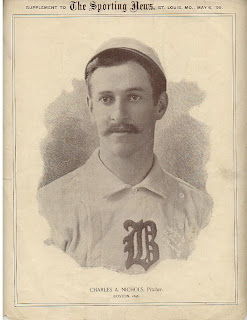

The players that I have been able to identify with 2 versions so far are:
1. April 29, '99 - Hugh Duffy
a. frame
b. no frame
2. May 6, '99 - Charles [Kid] Nichols
a. frame
b. no frame
3. May 30, '99 - Michael Griffin
a. frame - Brooklyn
b. no frame - St. Louis
4. June 3, '99 - Clark Griffith
a. frame
b. no frame
5. June 10, '99 - John Doyle
a. frame - New York (I'm pretty sure on this one, it's been awhile since I have seen the NY subject)
b. no frame - Washington
6. June 17, '99 - Bobby Wallace
a. frame, Cleveland, 1898
b. no frame, St. Louis, 1899
7. June 24, '99 - John O'Connor
a. frame, Cleveland, 1898
b. no frame, St. Louis, 1899
8. July 1, '99 - Louis Criger
a. frame, Cleveland, 1898
b. no frame, St. Louis, 1899
I have a good feeling that the other players not listed here that are in that date range - Bill Lange (4/15), Marty Bergen (5/13), "Wilber" Robinson (5/27) - also have the 2 versions.
My feeling is that the framed versions were the original supplement insert that was put into TSN for those weeks while the "updated" versions were part of the set that was mailed out later. Without knowing specfically when the sets actually began to be sent out, it is hard to say conclusively.
I have also yet to see a example of a framed subject after Criger
Would love any insight anyone has on this great set!
Thank you for taking the time to read my entry.
Once upon a time, I was heavily into baseball cards, starting with the fantastic 1972 6 series set. That set started me on a decade long run of collecting sets, going to local conventions and reading Sports Colectors Digest. Once college came along, I moved away from the hobby. A few years after college, I decided to get back into it and ended up completing the sets 1968-1980. Well, again, I went away from the hobby, and eventually as those who have read this blog know, I got deep into 1899 Spiders and went on from there.
One of the natural outgrowths of my 1899 research and my past collecting was to see if there were any "baseball cards" from my study era. The only ones I could find were an obscure large size issue called M101-1 (M for magazine) that was issued by The Sporting News as a supplement to their newspaper from 1899 through 1900. The whole set was also offered for purchase as well. Lew Lipset wrote a very good article on the set in the 1st issue of VCBC (Vintage Classic Baseball Collector) magazine.
Anyway, while continuing my batter strikeout research, I also continued to look for any M101-1's on eBay, or any other site that might have them for sale. This is not like T-206's or a Topps issue where cards are constantly up for auction or sale - you can go 2 years without seeing one up on eBay or one of the auction houses.
Over the years, I have been fortunate enough to acquire well over 40 of the 60 so subjects in the collection and as I did so, I started to notice some interesting features of this set.
One of these involved a change in font. Between May 5 and May 12, 1900, the font style of the heading "The Sporting News" changed:
Here is James McGuire from May 5:

Here is Bill Dinneen from May 12:

The font seems to be "softened up" (IMO) - I wonder if TSN had changed their font around this time for the actual newspaper as well. If anyone knows (or feels like checking Paper of Record), please let me know.
I originally observed a "color" change at this breakpoint as well from a brownish tone to more of a grayish tone, but I am not sure if this still is the case. My observation may be due to the quality and aging of the subjects, but there may have been an "ink change". Still not sure.
That was the main "change" in the issue I found, but what I also found was "alternate" or variation issues of a number of the subjects - all were towards the beginning of the run and a few indicated new teams.
The variations followed a general pattern - 1 issue had the player framed with a 2 line border and underneath the player's name, next to the team name, some indicates "1898" instead of "1899"
Due to the border, the heading sits higher on the supplement
Here is the 1898 version of Hugh Duffy from April 29, 1899:

Here is the "1899" version of Duffy:

Here is the May 20, '99 variations of Michael Griffin.
The first one indicates him on Brooklyn with a copyright notice from 1898 and the National Copper Plate mention (the M101-1's are based on an issue by the National Copper Plate company from 1898 - these do not have the TSN heading).

The alternate issue, has Griffin with St. Louis, 1899 and sans frame. The text on the back is essentially the same except for the additional text: "He was sold to St. Louis this spring, but so far has refused to report. He has bought an interest in a brewery at Utica, ans says he will not play ball again".

Here is Kid Nicols with the 2 versions:


The players that I have been able to identify with 2 versions so far are:
1. April 29, '99 - Hugh Duffy
a. frame
b. no frame
2. May 6, '99 - Charles [Kid] Nichols
a. frame
b. no frame
3. May 30, '99 - Michael Griffin
a. frame - Brooklyn
b. no frame - St. Louis
4. June 3, '99 - Clark Griffith
a. frame
b. no frame
5. June 10, '99 - John Doyle
a. frame - New York (I'm pretty sure on this one, it's been awhile since I have seen the NY subject)
b. no frame - Washington
6. June 17, '99 - Bobby Wallace
a. frame, Cleveland, 1898
b. no frame, St. Louis, 1899
7. June 24, '99 - John O'Connor
a. frame, Cleveland, 1898
b. no frame, St. Louis, 1899
8. July 1, '99 - Louis Criger
a. frame, Cleveland, 1898
b. no frame, St. Louis, 1899
I have a good feeling that the other players not listed here that are in that date range - Bill Lange (4/15), Marty Bergen (5/13), "Wilber" Robinson (5/27) - also have the 2 versions.
My feeling is that the framed versions were the original supplement insert that was put into TSN for those weeks while the "updated" versions were part of the set that was mailed out later. Without knowing specfically when the sets actually began to be sent out, it is hard to say conclusively.
I have also yet to see a example of a framed subject after Criger
Would love any insight anyone has on this great set!
Thank you for taking the time to read my entry.
Thursday, April 12, 2012
1888 AA Batter Strikeouts
I finished documenting all of the 1888 AA lineups and ended up documenting 98.2% of the batter strikeouts.
I went through all of the primary sources for each team with the exception of Louisville as well as double checked against ICI.
After my normal projected adjustment (very small due to the high completion %), here are the leaders for the 1888 AA:
1. Frank Fennelly, Cin/Phil - 83
2. Yank Robinson, StL - 78
3. Reddy Mack, Lou - 75
3. White Wings Tebeau, Cin - 75
5. Jim McTamany, KC - 72
6. Henry Easterday, KC - 70
7. Harry Stovey, Phil - 69
8. Jersey Bakley, Clev - 68
9. Silver King, StL - 65
10. Bill White, Lou/StL - 61
10. Darby O'Brien, Brook - 61
Bakley & King were pitchers who both started over 60 games each.
Among the best in the BK+ category (struck out the least compared to the league average), we have:
1. Louis Bierbauer, Phil - 434 (13 k's)
2. Pop Corkhill, Cin/Brook -302 (19 k's)
3. Oyster Burns, Balt/Brook - 277 (20 k's)
4. George Pinkney, Brook - 272 (22 k's)
5. Tommy McCarthy, StL - 247 (22 k's)
Other K-related stats:
Most k's by a pitcher: Ed Seward, Phil (vs. Lou), Aug 2 - 14 (extra innings).
Sources by city:
Kansas City - Times, Star
Brooklyn - NY Sun, NY Evening World
Cleveland - Leader, Plain Dealer
Cincinnati - Commercial Gazette
St. Louis - Republic
Baltimore - Sun, American
Philadelphia - Inquirer, Record
I'll add some other stuff in subsequent days.
I went through all of the primary sources for each team with the exception of Louisville as well as double checked against ICI.
After my normal projected adjustment (very small due to the high completion %), here are the leaders for the 1888 AA:
1. Frank Fennelly, Cin/Phil - 83
2. Yank Robinson, StL - 78
3. Reddy Mack, Lou - 75
3. White Wings Tebeau, Cin - 75
5. Jim McTamany, KC - 72
6. Henry Easterday, KC - 70
7. Harry Stovey, Phil - 69
8. Jersey Bakley, Clev - 68
9. Silver King, StL - 65
10. Bill White, Lou/StL - 61
10. Darby O'Brien, Brook - 61
Bakley & King were pitchers who both started over 60 games each.
Among the best in the BK+ category (struck out the least compared to the league average), we have:
1. Louis Bierbauer, Phil - 434 (13 k's)
2. Pop Corkhill, Cin/Brook -302 (19 k's)
3. Oyster Burns, Balt/Brook - 277 (20 k's)
4. George Pinkney, Brook - 272 (22 k's)
5. Tommy McCarthy, StL - 247 (22 k's)
Other K-related stats:
Most k's by a pitcher: Ed Seward, Phil (vs. Lou), Aug 2 - 14 (extra innings).
Sources by city:
Kansas City - Times, Star
Brooklyn - NY Sun, NY Evening World
Cleveland - Leader, Plain Dealer
Cincinnati - Commercial Gazette
St. Louis - Republic
Baltimore - Sun, American
Philadelphia - Inquirer, Record
I'll add some other stuff in subsequent days.
Subscribe to:
Posts (Atom)
Popular Posts
-
 I wanted to kick off this edition of my blog with a recent scan that I did from the 1912 Detroit Times (a bit large, but wanted to make su...
 -
A couple of years ago, when I was going through the 1910 Philadelphia Evening Telegraph as part of my batter strikeout research, I started n...
-
 In this blog entry, I am going to off normal topic a bit. As you may notice, I have renamed my blog to read "K's, Cards, and Thing...
 -
Living up here in Detroit, I have had a chance this season to see quite an enjoyable, albeit frustrating at times, Tigers team. They did w...
-
Still plowing my way through the 1888 AA Cleveland games and I think I have come across a "missing" player. In a September 5, 1...
-
I recently read of Zack Greinke having 3 consecutive starts for his team. They were not complete games, but I thought I would check my line...
-
For awhile I had been wondering who was the better "strikeout avoider" - Willie Keeler or Joe Sewell. Sewell's numbers have ...
-
While going through the 1888 AA Cleveland lineups, I ran across an interesting ending to a game that I wanted to go ahead and post. On Jun...
-
This morning I was going through the 1910 Chicago Tribune and ran across a rarity, so to say, a 5 strikeout game. This one belonged to Doni...
-
As I was going through the 1887 AA games a few months back, I ran across a game that I found a bit unusual for the time period - a team that...